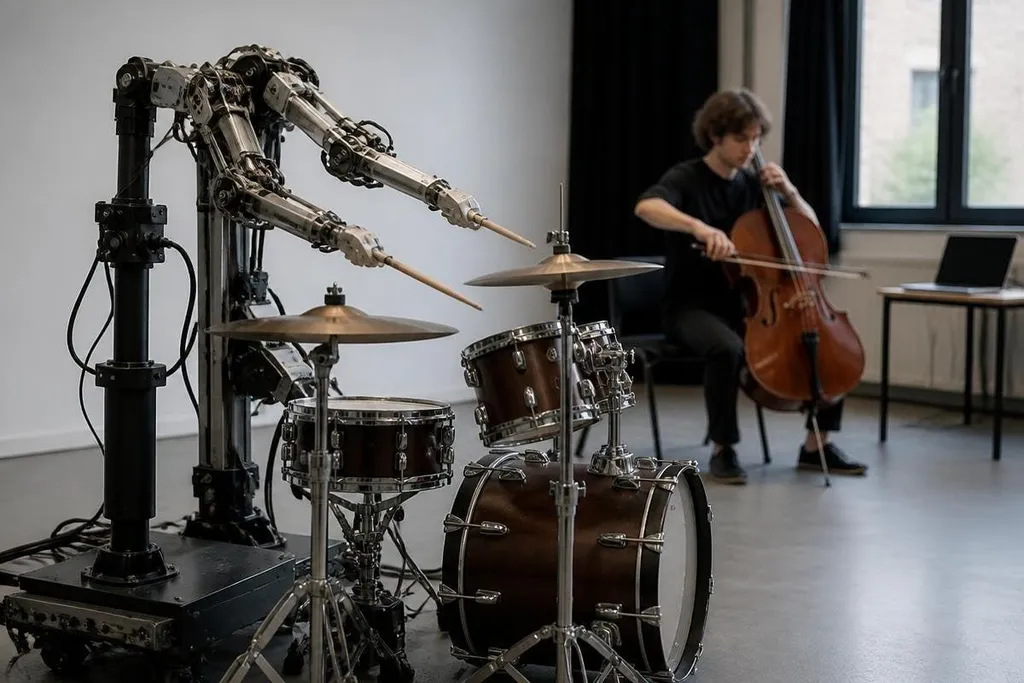
A robot musician can strike a drum, move a bow, or trigger digital notes through software. That makes the performance visible, repeatable, and easy to film, which helps explain the attention around these machines.
This article looks at the reasons people care, how the systems work, and where the limits remain. No growth figures or named performance results are available in the supplied material, so the claims here stay with the mechanics of robot music.
- Robots turn software commands into physical sound.
- Sensors help a machine adjust timing, force, or position.
- Human musicians still set much of the musical purpose.
The robot makes software physical
Music robots link code to movement. A controller sends commands to motors, and those motors move an arm, pick, drumstick, valve, or other part that creates sound.
That link gives the audience something to watch. A laptop can play a perfect sequence without visible effort; a robot shows the action through joints, arms, lights, and contact with an instrument. The movement becomes part of the performance.
The machine also makes timing easy to inspect. A digital score can set the order of notes, the gap between them, and the force used for each strike. The result can repeat closely when the hardware and software stay unchanged.
Repeatability has a practical use in music research. A team can alter one setting, run the same passage again, and compare the result. A human player may add more feeling or variation, but a robot can hold several test conditions steady.
The sound still depends on hardware
Software does not remove the physical work. Each robot needs an actuator, which is the part that creates movement, and a structure that keeps that movement within a safe range.
For a drum robot, control means placing the stick correctly and setting the force of each hit. String-playing systems must manage contact between the bow or pick and the string. Small errors change the sound, so the machine needs control over position, speed, and force.
Sensors add another layer. A force sensor can detect contact, while an encoder reports the angle of a motor shaft. Those readings let the controller adjust movement during a performance instead of sending commands with no feedback.
That setup helps explain why robot musicians attract engineers as much as music fans. The work joins robotics, control software, instrument design, and sound. A change in one part can alter the result from the others.
A public performance puts different demands on the evidence: the robot, venue, date, task, and operator need names. Robot24.com music robotics reports can place those facts beside the music, so you can judge what the machine adds before the article turns to the human timing it still struggles to copy.
The human part remains hard to copy
A robot can follow a score, repeat a movement, or react to sensor data. It doesn't decide what a song should mean, why a performance matters, or which mistake should remain in the recording.
Those choices sit outside the motor controller. A composer or musician still selects the notes, sets the tempo, chooses the instrument, and decides how much variation belongs in the piece.
The machine can also make a performance harder to stage. It needs power, control software, safety limits, and a physical setup that keeps people away from moving parts. A broken cable or stalled motor can stop the music even when the score is ready.
I'd treat a robot musician as a new instrument until a project proves it can do more than repeat a prepared sequence.
A practical test for new projects
When a robot musician appears in a video or live event, check these points before judging the music:
- Sound source: Identify the physical instrument or speaker making the sound.
- Control method: Check if the robot follows a fixed score, responds to sensors, or receives live human commands.
- Repeat test: Look for the same passage performed more than once under matching conditions.
- Human role: Find out who writes the music, selects the settings, and controls the system.
- Failure case: Check what happens when timing, contact force, power, or software goes wrong.
These details separate a moving prop from a working musical system. They also tell you what the project adds: a new sound, a new way to perform, or a better method for testing instruments.
The next useful question is not how human the robot looks. It is whether the machine creates a sound or control method that musicians could not get from a fixed recording, and whether anyone wants to hear it twice.